Mar 31, 2010

Burkas behind bars: Afghan women in prison

From RT

Most Afghan women are illiterate, face poverty, have limited access to healthcare, and subjected to continued and widespread violence. As if this is not enough, they are often arbitrarily imprisoned for “moral crimes”

Under the Penal Code of 1976, which is still in force, women can be punished for offences defined as “moral crimes”. These are mainly adultery and running away from home, often both combined.

The majority of female prisoners at Badam Bagh Central Prison for Women Offenders in Kabul are being held for violating social, behavioral, and religious norms.

When the taxi driver attempts to drop my Afghan interpreter and me off at Badam Bagh, the prison guards wave us off repeatedly, shouting that we are not allowed to stop at the entrance. With the increase of suicide bombings in Kabul they are terrified of explosions and view everybody with suspicion passing the prison.

Read more

After shouting out our identifications and reasons for visiting the prison through the open taxi window, we are eventually allowed to get out at the prison gate.

The prison guard who reads my prison admission letter is illiterate and holds it upside down, pretending to understand the writing. “You look OK,” he says, and gives us directions how to find the commander who is in charge of Badam Bagh.

The commander keeps a list of all the prisoners under a plate of glass on his desk. When asked what crimes they’ve committed, he tells me that he is very busy and that I should go and speak to the women themselves. Although some of the prisoners admit to crimes of murder, drug trafficking and attempted suicide bombings, many of the women I interview tell me they have been falsely accused of crimes by male members of their families.

Afghan prisoner in Badam Bagh Central Prison for Women Offenders in  Kabul. The majority of female prisoners in this prison are being held  for violating social, behavioral, and religious norms (Photo by by  Lizette Potgieter)
Click to enlarge

The wardens’ observation room, where I conduct my interviews, is crowded with upwards of twenty-five women, talking, weeping, and laughing. They range from late teens to late fifties, some heavily made up in tight-fitting tops and pants, others in traditional Afghan dress, with white or black lace-bordered pantaloons peeping from under long, full skirts. The young girls are unveiled; the older women, especially those from tribal areas, bear dark blue tattoos on their faces and deep orange henna on their fingernails, toes, and feet.

Zarmina, a petite twenty-six-year-old, is nervous and shy. She stares at her tattooed hands and twists her ring. The tattoos are the names of her six children, living with her mother-in-law in Ghazni, in central Afghanistan.

“I was very small when my mother died. When I was thirteen, my father sold me to a forty-five-year-old man. I was exchanged for his daughter, who was married to my brother. My husband was an opium addict. I told my father I wanted a divorce, but he didn’t care about me. My husband brought another woman into the house and had sex with her. He told me I should do the same. ‘Find a man and have sex with him,’ he said. I was with my husband for twelve years. He beat me and often attacked me with a knife. Look at my scars.”

Toward the end of their marriage, the couple moved to Iran, where Zarmina’s husband contracted HIV/AIDS. When they returned to Afghanistan, he at last agreed to a divorce. “I thought my life would change, but it got worse.”

The vast  majority of women and girls in Afghanistan have little knowledge about  their constitutional rights, no access to justice, and no power to  change their lives (Photo by by Lizette Potgieter)
Click to enlarge

“I went to live with my brother in Kabul, but he beat me all the time because I was divorced. I then left for Mazar-i-Sharif to be trained as a police officer. I wanted a job. My sister followed me to Mazar and tried to convince me to return to my brother’s house. She threatened me, saying: If you refuse, I will report you to the police and tell them that you tried to kidnap me.”

Nevertheless, Zarmina refused to return to Kabul. Her brother had her arrested on charges of kidnapping. She was imprisoned in Mazar-i-Sharif, where she spent a few weeks, before attending a court hearing in Kabul, where a male judge chose to believe her brother and sent her to Badam Bagh.

“I’ve tried to commit suicide three times: once when I was a child and twice while I was married. Every day I pray to Allah to let me die. A few days ago, I pushed a burning cigarette into my upper lip to kill the pain I feel in my heart. No one has come to visit me here. My brother threatens to kill me when I’m released. I don’t have a future.”

In jail, Zarmina is safe from her brother, and there are a few women’s shelters where she can be taken in secret to stay a few months while attempts are made to reconcile her with her family and/or find her a job. She has met only once with a defense lawyer during her ten-week stay in jail. She says the lawyer has no information on her, “doesn’t care, and isn’t helping me.”

The prisoners listening to Zarmina’s story all shake their heads in sympathy. “We are being kept here for no reason at all,” one says.

Shahpari  was sent to prison, she says, because “the rapists said bad things  about me to the police.” (Photo by by Lizette Potgieter)
Click to enlarge

Shahpari, a thirty-year-old tribal woman from northern Afghanistan, is soft spoken with thick black kohl lining the lids of her light-green eyes. She clutches her seventh child, a month-old baby born in her cell.

“I was twelve when I was married to a forty-year-old man. Six months ago I was kidnapped by two of my male relatives during the night at gunpoint. I was pregnant. They brought me to Kabul, where I was raped repeatedly for four to six days. The men told me they were going to sell me. I managed to escape and immediately reported them to the police in Kabul,” she recounts.

Shahpari was sent to prison, she says, because “the rapists said bad things about me to the police.” She originally received a sentence of one-and-a-half years, but for reasons she does not know, the term was increased another six months. A Supreme Court judge disregarded her plea for release.

“My husband has told me that when I’m free I can come back home, but he will not accept me as his wife, because I’ve been raped. ‘I will keep you to take care of my children,’ he said.”

Afghan  prisoners seek advice from a defense lawyer. Female defense lawyers have  little clout in court (Photo by by Lizette Potgieter)
Click to enlarge

Many international and Afghan NGOs strive to defend Afghan women’s rights, but they have little power and no legal staff. Medica mondiale Afghanistan provides lawyers in order to ensure the women get a fair trial. There are few female defense lawyers in Afghanistan, no public defense pool of lawyers as in the United States. At Badam Bagh – where free legal aid is provided by medica mondiale Afghanistan and the Afghan NGO Da Qanoun Goshtunky – prisoners complained of the slackness of the legal system and that female defense lawyers have little clout in court. Husbands are said to bribe judges to put or retain their women in prison.

Neither Afghan women nor men have access to lawyers at the police station during their first interrogation and may wait in detention for months before arraignment. Some never get a hearing. Time limits for detentions are rarely applied. The Supreme Court in Kabul, which covers the whole country, is responsible for thousands of cases referred from the secondary courts of Afghanistan’s thirty-four provinces, many of which offer no access to free legal counsel whatsoever. When time limits expire, detainees are not released, as provided by legislation.

The Family Court in Kabul is the only one in Afghanistan with a small number of female judges. Rahima Razai is the Head Judge of the Family Court. She is assisted by two senior female judges and one male judge. It was extremely difficult for me to set up an appointment with Judge Razai, who fears for her life and therefore did not want to reveal personal information. Judges have been killed outside their homes by suicide bombers or fundamentalists or family members angered by convictions.

Afghan  prison warden, Badam Bagh Central Prison for Women Offenders, Kabul  (Photo by by Lizette Potgieter)
Click to enlarge

“My job is very difficult,” she says. “I have to deal with complex family problems, corruption, and traditional culture.”

Judge Razai is not so much concerned with discrimination against Afghan women working in the current judicial system as she is worried about those who are imprisoned for so-called “immoral acts” and those who remain in prison while others can afford to bribe criminal justice agencies are released.

“Many women who have been raped are beaten, rejected, and put in jail,” Razai says. “Those who pay the bribes are released. Illiterate women with no power, connections, or independent means suffer particularly.”

“Only two basic points will solve the current situation in Afghanistan where women to a great extent are still regarded as ‘commodities’,” concludes Judge Razai. “Teach the men about human and women’s rights at the mosques; and teach boys and girls at school that they are equal.”

The vast majority of women and girls in Afghanistan have little knowledge about their constitutional rights, no access to justice, and no power to change their lives. Every small change and every bit of progress should be considered a major victory in a country governed by war, violence, corruption and ancient traditions.

Lizette Potgieter for RT from Kabul, Afghanistan

Mar 21, 2010

Marefat Celebrates the Success of its Students


37 girls and 23 boys are among the awarded students of Marefat High School. This is the fifth round of Marefat graduated students since 2002 when the school started its operation in Kabul from a bombed-out 4-rooms building in Poli Khosh, Dashti Barchi with a total number of 35 students. The school got accreditation in 2006.


37 girls and 23 boys are among the awarded students of Marefat High School. This is the fifth round of Marefat graduated students since 2002 when the school started its operation in Kabul from a bombed-out 4-rooms building in Poli Khosh, Dashti Barchi with a total number of 35 students. The school got accreditation in 2006.

Marefat High School is a tax-exempt entity registered as a non-prophet community sponsored institution in the Ministry of Justice, Ministry of Education and Ministry of Finance. The total number of students for the academic year of 2010 is around 2500, 42% girls and 58% boys. The school is led by a board of trustees comprised of 33 members from different strata of the community.


According to the officials, this year the capacity for the higher education system of the country is around 20%. Marefat students have gained nearly 95% successes in all their fifth round of graduations.

Mar 15, 2010

Worldview: Grassroots Afghan education


We all know the importance of educating girls (and boys, too) in poor Muslim countries.

So it is exciting to come across a successful educational model developed by an unusual Afghan educator to teach poor minority children. And it's a model with a special link to Philadelphia.

Kabul's Marefat School, the brainchild of Aziz Royesh, was built by the residents of a minority slum and teaches not only educational basics but principles of civic responsibility and humanistic values. I have visited the school and was bowled over by what it has accomplished.

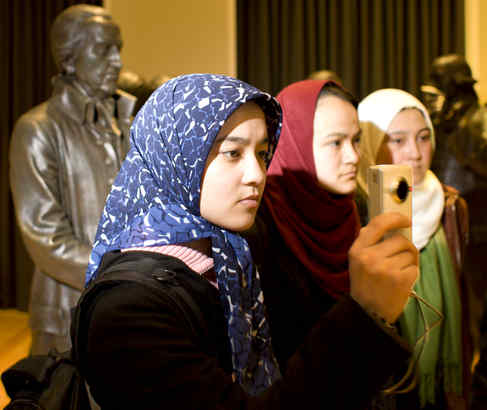
But equally fascinating: Last week, the National Constitution Center brought Royesh and a gaggle of Afghan boys in suits and girls in headscarves to Philly, where the Marefat School has been paired with Constitution High School, a predominantly minority charter school. The link with the Marefat School was made by a young Philadelphian, Jeffrey Stern, who spent two years in Kabul and now manages international projects for the Constitution Center.

Students of both schools are putting together an exhibit of photos about the meaning of freedom to minority groups. It will be shown the second week in May at the Constitution Center and later at the National Museum in Kabul. "Our school should be regarded as a branch of the Constitution Center," says Royesh. And the Marefat School should be regarded as a model for how Americans can help Afghans get the education they need.

What makes the Marefat story so exceptional is that it was built by poor Afghans who wanted better education for their children using small contributions and sweat equity. The inspiration came from Royesh, a compact man with a neat beard who was forced to abandon his own formal education when he fled the Soviet occupation of Afghanistan in the 1980s. He educated himself and began setting up schools in Afghan refugee camps in Pakistan. continued on...

Mar 13, 2010

Afghan, Phila. students in joint photo project

By Elisa Lala
Inquirer Staff Writer


Fatema Jafari, 15, of Afghanistan, had never walked around the streets of Philadelphia before this week, but she feels as though she has.

She has spent hours looking into the eyes of the street vendor selling hot dogs to passersby, stared mesmerized at the mirrorlike Comcast building overlooking the city skyline, and seen American families eating birthday cake, dancing in street parades, and riding bikes.

Jafari has experienced Philadelphia through photographs.

She is one of 10 Afghan high school students participating in an international photography project in collaboration with 11 students from Constitution High School in Center City.

When they started the project in July, none of the students had any formal training in photography. Some had never even held a camera, but all 21 wanted very much to share images of their lives with students from the other country.

The two groups have spent the last eight months capturing their respective cultures and sharing them on a blog.

Yesterday, they came together in a back room of the National Constitution Center. Acting as curators, they thumbed through more than 400 photos scattered on three tables. They selected a dozen or so to be displayed on the walls of the center in an exhibition to open May 14 titled "We the People: Afghanistan, America, and the Minority Imprint." Continue reading...

Feb 26, 2010

Mother While Pray

My mother I love you and I need you, even tough
I love you and I need you, even tough
Your presence and your loves are always there
You are my jail cell and ten-ton door
That keeps me from just being who I am
And so I pound the walls and go to war
Ramming all the rules that I can ram
Yet though I mast rebel, all the while
I know your love’s the ground on witch I stand
I wait upon the flash of your pound smile, my mother
And twist inside at every reprimand
I’m sorry for the times I’ve caused you pain
After these brief storms, love will remain
Click here to see more photos

Feb 21, 2010

Was Taliban leader's capture really a good thing?

From CNN

As coalition forces and insurgents battle each other in Marjah, some NATO and Afghan officials are talking about integration and reconciliation. CNN's Chief International Correspondent Christiane Amanpour spoke with Taliban expert and journalist Ahmed Rashid, who's written many books on the subject, including the best-selling "Taliban." They discuss how Mullah Abdul Ghani Baradar's capture could be a Catch-22, the likelihood of Taliban reconciliation and if there have already been secret meetings between the Taliban and Afghan government to discuss this.

Watch an excerpt from the interview
Related: U.N. envoy: Reconciliatory efforts needed in Afghanistan

Related: Afghan offensive likely first of many

Q: Are there any ongoing contacts with the Taliban?
A: There are. All the major international humanitarian agencies had had indirect contacts with the Taliban, not on a political basis, but basically protect their humanitarian activities, for example, protecting the school and health programs that they are running. The U.N. has been in the same position. For example, the U.N. had a very good polio inoculation campaign across the country in Taliban areas, as well. Now, that couldn't have been carried out unless there had been some kind of contact with the Taliban to give access to the nurses and doctors who went into carry this out. So that's the first reason.

I think the second reason is that the U.N. has been very deeply worried by the attack on its offices and one of its guest houses in Kabul a few weeks ago.

Q: Why did that happen? Because it's really one of the first times that's happened.
A: I think the assumption is that it was the main Taliban grouping based in Pakistan and was that some of the allies of Taliban who are more closely linked to al Qaeda, and was that done to, in fact, sabotage the relationship between the United Nations and any ongoing talks that might be held.

Q: First and foremost, it's all very nice that the U.N. talks on humanitarian issues and their polio vaccine, but that's not exactly what everybody's getting their hopes up, in terms of a political channel to bring the Taliban in. Is there any political channel of any credibility that's happening right now? [The U.N. special representative to Afghanistan] Kai Eide says no.
A: I think there is a channel that has been opened, and everybody acknowledges that that channel has to be carried out by President Karzai and the Afghan government. And all the others - you know, the Americans, U.N., everybody else should be - should help that channel, but they have to be for the time being bystanders.

Q: So how far is it? How far is it along?
A: There have been talks - there were talks much earlier in the spring of last year in Saudi Arabia, but there have been talks this winter again in Saudi Arabia. And, in fact, several of the Taliban leaders have been in Saudi Arabia meeting with the Saudis and also meeting with representatives of the Afghan government.

Q: But in terms of who do they represent, do they represent Mullah Omar? Are they real, credible Taliban who can actually deliver something?
A: The fact is that Mullah Baradar - this No. 2 who was arrested in Pakistan - was in Saudi Arabia for hajj just a few months ago. And all the reports are that he certainly did have talks, and there was a dialogue going on with the Saudis, with members of the Kabul government, and that is one of the main venues.

Q: So why now then? Why his arrest right now, if he's one of the main interlocutors?
A: I think there are many levels of problems here. The first thing is that I think the Pakistanis obviously have been under huge pressure to arrest active members of the Afghan Taliban who've been living in Pakistan for years and years.

Now, the Pakistan's ISI, the Inter-Services Intelligence, could have arrested these people at any time. The question is, why did they choose to arrest them at this time? And I think one of the reasons is that the ISI wants to send a very firm message to the Taliban and to the Americans, also, that if there's going to be any talks or dialogue between Kabul and the Taliban, Pakistan will have to be the main broker or mediator.

Q: So this is a shot across the bow then?
A: In a way, it's a help across the bow, because you've arrested Taliban leaders, but certainly it's sending a very strong message by the ISI and the military in Pakistan to all of NATO and the Americans that, you know, don't go into talks without telling us because we are the key players here.

Q: So Richard Holbrooke, the special envoy for Afghanistan and Pakistan, has praised this. He's met with the Pakistani prime minister. He's called it a significant move. Is it a significant move in the right direction? Yes, they've got this top man off the battlefield, but does it hurt in the other direction, in terms of political reintegration?

A: I think, in the long term, it will hurt. Why? Because Mullah Baradar is a very serious No. 2 of the Taliban. He's very close to Mullah Omar. He would not have gone to Saudi Arabia and met these people, frankly, without permission of Mullah Omar. I think this is a Taliban joint effort. Mullah Baradar is not some rogue element who's talking on his own or he's not a moderate Taliban who's talking on his own.

So I think the Americans, of course, are faced with this dilemma that they want to encourage this amongst the Pakistanis, but the problem now is that, if Mullah Baradar was going to be the main negotiator, he is now tainted, he is now arrested. He will now be seen by many of the Taliban and even by members of the Afghan government as an envoy for Pakistan rather than an envoy from his own movement, because this is a man who's been arrested and been interrogated.

Even if the Pakistanis want to use him now as a mediator and they set him free, you've tainted him.

Q: Given that you say he's so close to Mullah Omar, are there red lines? How does one deal with the Taliban, if you want to bring them in from the cold? How do they deal with the women's issue? How do they deal with the al Qaeda issue?
A: There has to be a political formal process of dialogue. And certainly, one of the main demands - the major demands of the Americans - is that they have to show signs that they've broken with al Qaeda. Now, the mainstream Taliban, which is represented by Mullah Omar, could possibly do this.

Now, how will they actually demonstrate this? That's the problem. How do you prove that you've broken with al Qaeda? It's not good enough for me to say, "I've broken with al Qaeda." I have to prove it on the ground. And one way I can prove it on the ground is actually by going after al Qaeda.

So would the Taliban be willing to actually go after al Qaeda? Because they know where al Qaeda is more than anyone. But don't forget that there are other elements here amongst the Afghan Taliban, the Haqqani network, Gulbuddin Hekmatyar, who are very close to al Qaeda, who would do their utmost to sabotage any kind of dialogue like this.

Q: Let's talk about U.S. strategy in Marjah right now. ... Give us an idea of where the concentrations of Taliban are.
A: The Taliban control most of the south and a lot of the east. They control some of the provinces. They have a very strong presence around Kabul, and I think that's where the next offensive, Western offensive will be. They are strong in the north. They have pockets in Kunduz in the north and in the west, in Herat, and other provinces in the west. So it's become now a countrywide movement.

Q: Can [coalition forces] win the support? Are they bringing better governance? And are they telegraphing that message well enough?
A: Well, it's going to be piece by piece. This whole Marjah offensive is all about bringing governance - as General McChrystal has said, government in a box - to what is a critical area. It is, first of all, the poppy area. It is the concentration of the Taliban. And it was also the supply route for logistics going into Pakistan, where a lot of their recruits and logistics come. If you can settle that area, win the confidence of the people, certainly that would be a big blow, but you will have to repeat this many times in the next year or 18 months all over the country, particularly in the south, but in the east, you have to clear these provinces around Kabul, you have to push the Taliban back.

Q: Will the U.S. and NATO forces win praise for what they did, which was so loudly telegraphed this, in order to get the civilians out of harm's way? Certainly some Afghan officials are already saying that the majority of people in that area are pleased at the fact that there was so much notice given.

A: This is a completely new and different strategy, and I think it's a very positive strategy, and I think it's been met with a lot of positive response by Karzai, by the government, and by the local people. There's enormous care being taken. The 12 civilians who were killed by this rocket attack - General McChrystal was quick to acknowledge that, to apologize for that, and then to take action against that. So I think this is a way to win hearts and minds.

Feb 10, 2010