It’s a bit of a family joke. How my mother, Frances D’Souza, is always trying to save the world. You name the disenfranchised group, she’s campaigned on their behalf. You recall the earthquake and she’ll have been there to help. That do-gooderish gene, that compulsion to get involved, the Tigger-like verve for adventure? Not to mention the maddening lack of material greed, who knows where that came from. But one thing’s for sure, it’s not been passed on.
Or maybe it has, but after years of having her at the site of some disaster or travelling with the Mujahidin or off fighting the fatwa against Salman Rushdie, as opposed to sitting at home and looking after me, the gene may have gone into hibernation. Of course, I was happy for her when she was made a life peer in 2004 (when she became Baroness D’Souza of Wychwood) for her work in human rights, but have I ever thought of following in her footsteps? Forget it. Our worlds, they could not collide less.
Until now, that is. For here I am, sitting next to her, watching dawn break over the snow-peaked Hindu Kush. Along with a group of big, loud, heavily tattooed Texans, we are on a Kam Air flight to Kabul to visit a school she helped establish in 2002, soon after the Taleban were driven out.
It being a surprise visit, my mother has not yet told its head, Aziz Royesh, we are on our way. This is partly because she wants it to be the Ofsted-style inspection it would be if the school were in the West, and partly because, as Royesh told her in an e-mail three weeks ago (they only get three hours of electricity a day), the school was recently attacked by religious hardliners. So we have come out to offer our moral support in as low-key a manner as possible. It is unbeknown to Royesh, then, that the pair of us are lurching along the road from the airport to Dashti Barchi, the poor, predominantly Hazara-inhabited district in West Kabul where Marefat stands, far away from the central market and Chicken Street (where all the foreign aid workers congregate).
Sadly, we are minus the two encyclopaedias ordered from Amazon that didn’t arrive in time. We have in their stead, however, bag upon bag of Haribo, a couple of giant jars of Gold Blend and canisters of boiled sweets (which can be used instead of sugar in tea) from the duty-free shop in Dubai.
My mum had told me to put on a bit of make-up for the girls, make myself look as much the fashion magazine contributing editor as is possible under the circumstances. But I’m afraid I haven’t quite got it together. I’m too busy adjusting my Bamford headscarf, which keeps slipping off, and looking at the scene out of the window: the wide, gracious but deeply rutted roads; the market stalls heaving with watermelons and monster-sized pomegranates; the marmalade-haired, pale-eyed Nuristanis (supposedly descendants of Alexander the Great) and the blue burka-ed mothers carrying their children on their bellies, rather than on their sides (so as not, my mother is convinced, to accentuate their hips). Then there are the truckloads of young turbaned men toting bullet belts and casually cocked Kalashnikovs, peering dully at us through the car window.
This trip, it nearly didn’t happen. Having finally been persuaded by my other half that this was precisely the sort of thing I should be writing about (as opposed to the stuff I usually do: breast implants and wearing short skirts at 50), having informed my mother that we were, as they say, “goin’ in”, having got my ticket to Kabul and victoriously waved it in my other half’s face, there’s a setback. The office of Mark Malloch Brown, then a Foreign Office minister, e-mails my mother, advising her in no uncertain terms not to go. “Kidnapping by criminal gangs is still a very real danger,” it reads, “and we would advise you not to go unless you absolutely had to.” It goes on to say that, should we decide to fly out anyway, the embassy in Kabul will not be able to provide us with any security.
None of which worries my mother, who has recently visited Helmand and Kandahar, pops in and out of Kabul all the time, and doesn’t plan on using security anyway? But it does give her second thoughts about taking me. I am her daughter, after all, she rationalises, and she’d never forgive herself if anything happens to me. Which in turn gives me second thoughts about the whole idea. Am I being a bit mad? Is it fair on my children?
I then get a message from my mother saying she’s changed her mind, it would be fine to go. The FO is merely being cautious, what we are going to do is pop in, pop out and not bother with security because we’ll probably be safer without it. “Sorry, can’t talk now,” her breezy e-mail continues. “Crisis at House of Lords, see you at weekend. Love, Ma.”
I phone my colleague Jemima Khan, who tells me to call her friend Rory Stewart, the Old Etonian whose travels on foot across Afghanistan are chronicled in his book, The Places In Between. As it turns out, Stewart has visited Marefat, is a big champion of my mother, and is horrified to think I am passing up a chance to see Afghanistan and the place he’s nicknamed “the St Paul’s of Kabul”. Of course I must come out, everyone should come out – “It’s not Bogotá, after all” – and not only should I come out, my mother and I should stay at Turquoise Mountain, the artistic compound he has set up in a fort in the old part of Kabul.
Knowing I’m sleeping in a bed in a lovingly restored historic fort with a flushing loo, knowing we are probably safer with Rory’s driver Zia, in his dusty old Renault estate, than an armoured vehicle with UN emblazoned on the side, I feel relatively at ease here. I feel relatively inconspicuous, too: green eyes and reddish-brown hair are quite common.
We finally take a turning off the main road. At the end of a gouged-out dirt track looms the main school building, an extremely rudimentary, two-storey mud and daub block, protected, ever since the attack, by two sleepy security guards with Kalashnikovs. On the other side of an alleyway is the building where the girls’ classes are taught, as well as the cramped four-room compound where Aziz Royesh lives with 19 members of his family.
As we step across this alleyway, over a rivulet of sludge on top of which float empty Pepsi cans and boiled sweet wrappers, a gaggle of young male pupils, in dusty ties and jackets crowd round, all of them with the rosy cheeks and Asiatic eyes peculiar to the Hazara (supposedly inherited from Genghis Khan’s Mongol hordes), and squint at us through the sun. These are the same Hazara people we read about in The Kite Runner, the minority Shia Muslim tribe who make up around 10 per cent of the estimated 27 million population (predominantly Sunni Muslim) of Afghanistan. The same people who were either beheaded or shot in their thousands in 1993 by Ahmed Shah Masood’s Sunni troops (the famed “Lion of Panjshir”); and the same people who were later so brutally targeted by the Taleban, with men, women and children randomly mowed down in the streets by gangs in white Datsuns, their bodies left to rot or be eaten by wild dogs.
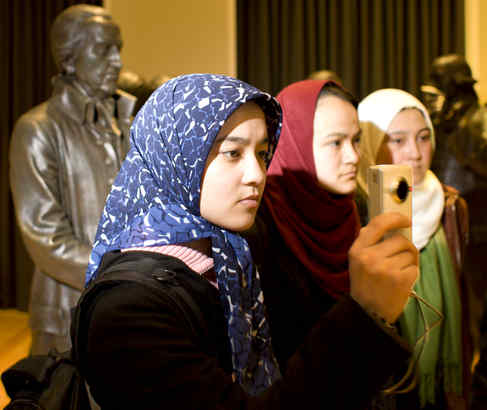
As we make our way in through the fort-like entrance, hundreds more children, girls as well in their starched white hijabs, gather round us, and, as they create a narrow path for my mother and me to walk through into a sweltering courtyard, they shyly reach out to touch her and clap and shout out her name: “Ama [Auntie] Frances, Ama Frances.” Royesh, meanwhile, is waiting for us at the top of a rickety steel balcony. “I can’t beh-leeeeve it, I can’t beh-leeve this is happening,” he keeps squealing repeatedly, while squeezing her hand. The pride I suddenly feel for her, the admiration, after all these years of being so fastidiously uninterested and dismissive and cynical, is overwhelming. Please, oh please God, don’t let me cry.
Royesh, who learnt English in a Pakistani refugee camp, first met my mum when she was on a mission to Kabul for the Westminster Foundation for Democracy, an independent public body sponsored by the Foreign Office.
She remembers how Marefat looked then: a bombed-out, roofless mud hut with a sheet across the middle of it to create “classrooms” – no textbooks, no blackboards, no desks, no electricity, no water, just 30 eager “students” aged from 7 to 35, all desperate for an education. One illiterate woman she met explained how she wanted to learn geometry so she could divide up her land for her grandchildren. Then there was the ten-year-old carpet-weaver who said that the reason he wanted to learn to read and write was because he wanted to become an “intellectual”.
It was Royesh himself, though, whose childhood heroes were Gandhi and Che Guevara, who was so passionate about bringing education to his people and teaching them the concepts of democracy, who impressed her the most. So after going back to London and getting bored with the way the Westminster Foundation kept faffing about, she decided to go it alone and back the school herself.
Slowly, with small tranches of money raised by Mum through the generosity of friends and foundations (and the odd, sometimes ill-attended clothes sale in her village hall in Chipping Norton), Marefat began to grow. Community elders donated land on which to build. Parents – though many were wary at first about the idea of their daughters being educated – helped build it, brick by brick. A local businessman donated a school bus. American agency USAID, prompted by my mother, donated a generator, which Royesh very gratefully accepted – but only on condition that the parents pay for the diesel. (He was adamant that Marefat, unlike many an NGO-supported project out here, be able to stand on its own two feet.)
Seven years and a piddling £60,000 later, Marefat has 95 qualified teachers and educates 3,150 students (44 per cent of them girls), the majority of whom go on to study medicine, economics, law and engineering at university. The child carpet-weaver sponsored by the Marefat Charity Box my mother set up is now a scholarship student at the American University of Afghanistan.
Humanism, philosophy and Christianity are taught, as well as interpretation of the Koran; reading lists include Hegel, Kant and Bertrand Russell’s The Conquest of Happiness (one of Royesh’s favourites); and, perhaps most important of all, the students are encouraged to be politically aware, to know the meaning, as Royesh puts it, of “mobocracy”. (The week before we were there, for example, the children had put on a satirical play about candidates in the upcoming elections, one playing an ex-prisoner from Guantánamo Bay pushing for legislation for more sleep, another pushing for more hashish smoking, and so on.) This, in a country where, three years ago, a teacher was beheaded for educating women; in a country where, we are told, despite the Karzai government’s current claim that six million children are registered at school, many teachers (particularly in rural areas) are themselves poorly educated.
We have unwittingly arrived on Teacher’s Day (Teacher’s Day – imagine such a thing in some of the schools in the UK); a lot of glitter is scattered in gratitude on to the adults, and all the kids are on parade. Managing to resist the urge to crouch as a plane flies low overhead – I feel vulnerable in this courtyard – I follow my mother and Royesh to one of the first-floor classrooms.
“Oh, look,” she cries, having just been shyly handed a plastic-beaded mirror and a fake rose by one of the girls. “I recognise those.” She is pointing to three canvases hanging up, one of Einstein, one of Shakespeare and one of – can it really be? – Whoopi Goldberg. Royesh, speckled with glitter, clasps his hands in delight at the comment. These are done by Nasrifah, the same pupil who painted a portrait of my mother that Royesh proudly lugged all the way over from Kabul on his last visit. I remember seeing it propped up in her tiny House of Lords office and wondering where she was eventually going to put it, given that in the picture, she has bountiful “Let a thousand flowers bloom”-style hands outstretched to happy, smiling children.
Round the edges of the next classroom, a group of 5th-grade female students are lined up with white paper cones perched on top of their heads. On each cone is written one of the elements: hydrogen, copper, etc. On a rickety table in the centre are models of molecules made out of discarded Coke cans.
Resources for experiments, as science teacher Parwiz Abrahami, an Afghan expat from Seattle, tells us, are limited. There aren’t many frogs around to dissect, no proper labs equipped with Bunsen burners and goggles, but “we try to do stuff with what we can”. A med student on sabbatical who is only here after chancing upon my mum’s blog about Marefat last year, Abrahami goes on to explain how they have learnt to check each other’s blood types, and have performed experiments which have involved extracting DNA from a sheep and harnessing hydrogen gas. “Of course, in the States we’d have a balloon to catch it,” says Abrahami. “Here we had to cut off the finger of a rubber glove and tie it with a rubber band.”
This is all in stark contrast to the blue- domed madrassa, 15 minutes across town, whose students were involved in an attack on Marefat three weeks before our visit. Run by Ayatollah Mohseni, the cleric behind the controversial Shia Family Law (which appears to legalise marital rape and child marriage), and backed by the Iranians (to the eventual tune of perhaps $55 million – £34 million – suggest some sources), the Khatam-ul-Nabieen seminary and mosque provide free bed and board to students, as well as lessons in Mohseni’s fundamentalist credo. Marefat, Aziz Royesh explains, has been a thorn in Mohseni’s side for some time now. Through the Iranian-sponsored TV station Tamadun and the madrassa, Mohseni has been preaching against the school and even Royesh himself, for spreading Western propaganda and teaching “non-Islamic” subjects.
It all reached fever pitch after some of the female students from Marefat joined a peaceful gathering outside the madrassa protesting against Mohseni’s law. As reported in the Hazaristan Times in April, a mob of madrassa students some 50 to 60-strong descended on the school in the morning. They encouraged poor, illiterate locals, some of whom were relatives of the pupils, to join in, pelted the windows with stones and called for Royesh’s immediate execution, forcing him to lock all the doors and call the police. By the time they arrived two hours later, more pupils from other local madrassas had joined in, and the crowds only dispersed after the police fired shots into the air.
It is now noon, and Royesh has brought us to his family compound. With only an hour’s advance notice, a huge spread of caramelised Kabuli rice and mutton dahl, and sheets of naan bread to dip it in, has been prepared by the womenfolk and laid out for us on the carpeted floor. A few of the teachers have been invited, as have some of the male members of Royesh’s family. There are also five female students, including Royesh’s own daughter, Farida, 16, who, having graduated from Marefat at the age of 13, is now studying economics at Kabul University. Historically, Hazara women have always played a significant role within the community, entering politics and even, on occasion, fighting alongside the men in times of war. Today, however, even though Royesh is encouraging them to speak out and to ask Frances and me questions, they seem hesitant to speak up in front of the men.
It is only later, when Royesh takes my mother off to look at the new building her latest instalment of money has bought (a three-storey construction which will take just 25 days to put up), that I get a group of the women to myself, and they begin to open up. They tell me about the demonstration some of them participated in outside Mohseni’s madrassa, how members of their own community, spurred on by Mohseni’s Tamadun TV station, called them “dogs” and “slaves of Christians”.
One, an extraordinarily beautiful young woman called Adela, 21, who could neither read nor write when my mother first met her 7 years ago, yet is now thinking of taking a master’s degree, tells of the difficulties she had persuading her ultra-conservative family that it was right for her to join the protest, that women should be equal to men. Another, Baihana, a serious-looking girl with alabaster skin, ginger hair and a sprinkling of freckles across her upturned nose, explains how she wants to become a doctor. She does not want to practise abroad, however, intending to stay here to help her people.
All of them look quite baffled when I tell them how brave I think they are, and even more so when I tell them that, when I was their age, I rebelled like mad against Frances. “You rebelled against? feminism?” one shy but horrified girl of about 13 haltingly asks. Although they giggle like any other teenage girls when I bring up the subject of boys, and profess to be hooked on Harry Potter and the TV series 24, it is the concepts of “feminism” and “women’s liberation” that they are most interested in. “How do you combine being a Muslim, a woman and someone who is politically involved all at the same time?” asks another student, who lives 100 kilometres away in a rural community near Jalalabad.
That night, a group from Turquoise Mountain, including its American director, Shoshana Coburn, and its boyish, public school-educated head of security, John Elliot, takes us to a well-known French restaurant called L’Atmosphère. Situated in the “posh” part of Kabul, on a street lined with sprawling NGO villas protected by barbed wire, Latmo, as its loyal expat clientele call it, is guarded, as usual, by men wielding AK-47s. There are three stone “chambers” you must pass through, with passport and body searches in each one, before you emerge, as if in The Lion, the Witch and the Wardrobe, into a canopied garden terrace.
So this is where all the cool, single NGO workers (and there are many of them) hang out. This is the place that must remind seasoned war correspondents of the old days in the Sixties and Seventies, when Afghan women wore miniskirts and the pro-Western King Zahir Shah ruled. There’s even a swimming pool out the back where you can lounge around in a bikini while sipping a cocktail. What would Adela or Baihana think of this place? Or, indeed, the upper-school pupils we’d met earlier in the day, who prefaced each of their carefully constructed questions with “In the name of Allah...”?
How very far away it feels from Marefat, despite the fact that Dashti Barchi is only 25 minutes’ drive away.
Over chilled French rosé, and tartare de thon and foie gras, we talk about Royesh’s indomitable spirit and the fragile future of Marefat. We talk about the pupils’ most un-Western thirst for knowledge, and how fabulous it would be if we could get our own perfectly receptive, perfectly inquiring children to value knowledge even a tenth as much as the kids at Marefat. We talk, too, about the billions upon billions of aid poured into Afghanistan and how most of it, inevitably, ends up in the government’s pockets or in the Western bank accounts of ludicrously overpriced contractors. And of Royesh’s ambitious but wonderful plan to duplicate the Marefat model elsewhere in Afghanistan.
Back in London, life is as it was. I’m at my computer writing the definitive piece on – what is it this time, eyelashes? – and Frances is firefighting at the House of Lords. Except, of course, life is not the same as it was. I’ve been bitten, as it were, by the bug. I’m beginning to get it, at last, the need she has always had to get out of her comfort zone to feel alive. I am beginning to understand, too, that compulsion of hers to get involved, that dogged belief that every little bit really, really does indeed help. They say, don’t they, every daughter turns into her mother eventually. If this is so, well, then lucky old me.


.jpg)




 Q: Are there any ongoing contacts with the Taliban?
.jpg)

.jpg)

